Our services
At Plast‑ANQO, all analyses are conducted in accordance with a rigorous QA/QC (Quality Assurance / Quality Control) framework. This approach ensures the reliability, traceability, and reproducibility of every result.
Quality Assurance (QA) encompasses all procedures governing our analytical activities, including validated protocols, controlled documentation, equipment monitoring, continuous staff training, contamination control, and adherence to good laboratory practices.
Quality Control (QC) refers to the checks performed on each analytical batch, including blanks, duplicates, reference materials, calibration curves, instrumental performance checks, and predefined acceptance criteria.
By combining these two components, Plast‑ANQO delivers robust and interpretable data, essential for supporting public, private, and academic stakeholders in decision‑making, environmental assessments, and research projects.
Microplastic analysis and identification
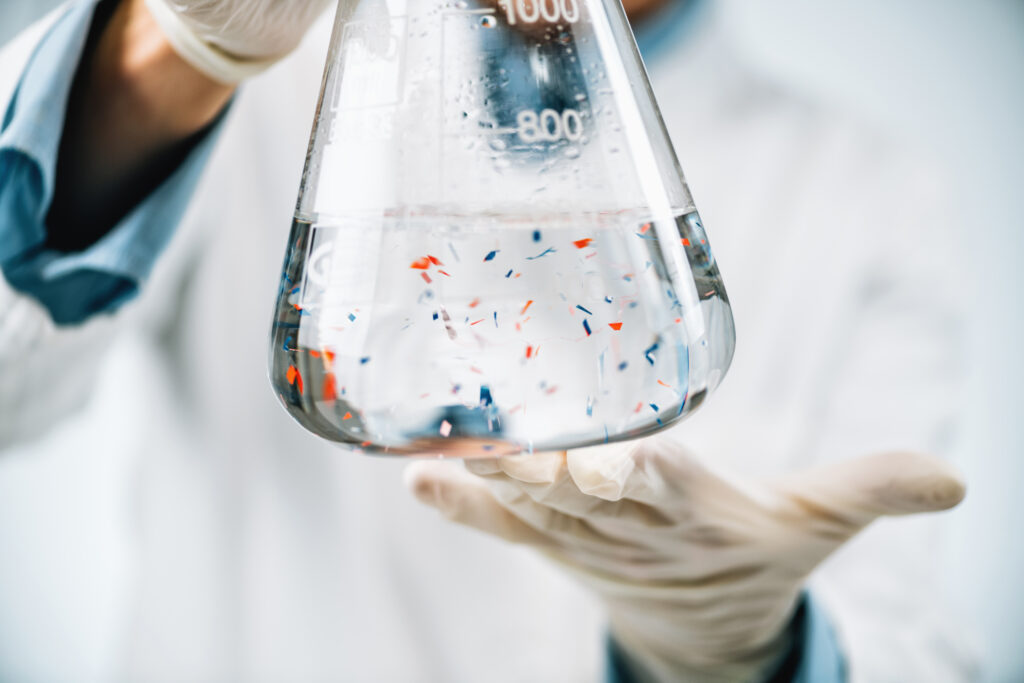
Microplastic analysis in water samples
Microplastic analysis in water samples is based on ASTM D8401‑24, currently regarded as an international reference standard for the quantification and identification of microplastics by pyrolysis‑GC/MS. This standard governs every step of the process, from sampling to characterization, and sets strict requirements for cleanliness, quality control, and traceability.
By placing this standard at the core of our analytical protocols, we ensure robust, fit‑for‑purpose, and actionable results, designed to address real project needs: understanding an environmental system, meeting regulatory requirements, or supporting informed decision‑making. With this approach, our analyses provide genuine scientific support rather than isolated numerical outputs.
Thermal analysis of microplastics and polymers
Pyrolysis coupled with GC/MS is central to our analytical strategy. It enables precise and reliable identification of polymer types and microplastics, even in highly heterogeneous samples. The technique delivers a clear chemical fingerprint that facilitates interpretation and decision‑making, whether to confirm composition, compare materials, or address a specific analytical question.
This approach also provides robust quantification of targeted polymers, ensuring results are supported by consistent and comparable quantitative data. When relevant, complementary thermal analysis tools such as DSC or TGA can be implemented to provide additional insight. Our objective remains straightforward: to select the most appropriate analytical combination to deliver clear, reliable, and exploitable results.
Polymer characterization
To complement chemical identification, we offer a suite of advanced analyses aimed at deepening the understanding of polymers and microplastics. Chromatographic techniques such as size‑exclusion chromatography (SEC) and field‑flow fractionation (FFF) enable the determination of size characteristics and molar mass distributions, providing detailed insight into macromolecular structure.
Imaging techniques, including electron microscopy and atomic force microscopy (AFM), offer direct visualization of particle morphology, which is particularly valuable for complex or heterogeneous materials. Finally, structural methods such as nuclear magnetic resonance (NMR) spectroscopy allow detailed confirmation of polymer molecular architecture.
Together, these complementary analyses strengthen overall interpretation and deliver a comprehensive, coherent, and reliable characterization of your samples.
Development of tailor‑made analytical methods
Targeted analysis
Targeted analyses focus on a specific polymer, using custom‑designed calibration samples developed to address the client’s specific needs. At Plast‑ANQO, this approach ensures accuracy and reliability of results, even for complex samples. It enables the selective detection and quantification of a polymer of interest, delivering robust and directly actionable data to support scientific, regulatory, or industrial decision‑making.
Analysis in complex matrices
Certain matrices present specific challenges that require adapted analytical methods. At Plast‑ANQO, we develop tailored protocols for these complex samples, with particular attention paid to sample preparation to ensure efficient extraction and preservation of the target microplastics and polymers.
This tailor‑made approach provides reliable and reproducible results, even in samples with significant interferences, and supplies clients with solid, exploitable data for their studies, assessments, or industrial projects.
Expertise & advisory services
Project support
Plast‑ANQO supports public, private, and academic project leaders by providing comprehensive scientific and regulatory guidance. We assist in defining analytical requirements, selecting the most appropriate methods, interpreting results, and ensuring compliance with applicable standards and regulations.
This tailor‑made support enables our partners to make informed decisions, secure their projects, and maximize the reliability and relevance of the data generated.
Training
Plast‑ANQO offers customized training programs designed to strengthen understanding of analytical protocols and result interpretation. These sessions are intended for research teams, industrial stakeholders, and public institutions seeking to better leverage data generated from polymer and microplastic analyses and to use it effectively within their projects.
If you have a specific and clearly identified need, we can design a bespoke training program tailored to your objectives. Please contact us to discuss available options and jointly develop a training course aligned with your expectations.
ADERA is a training organization certified QUALIOPI, ensuring the quality and compliance of its educational services.